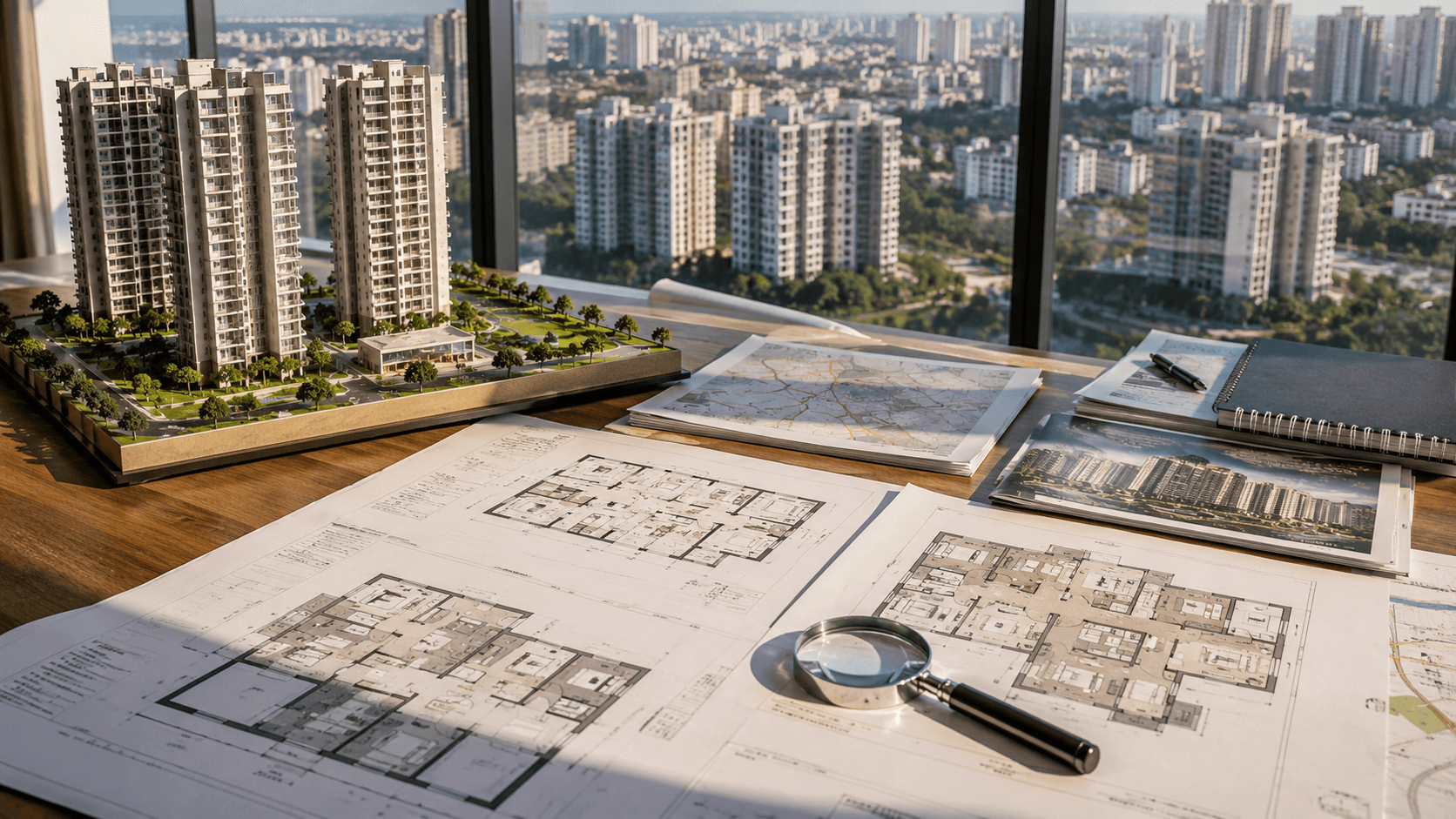

- 01Brochures are marketing material. Only the RERA-registered floor plan and registered sale agreement are legally binding.
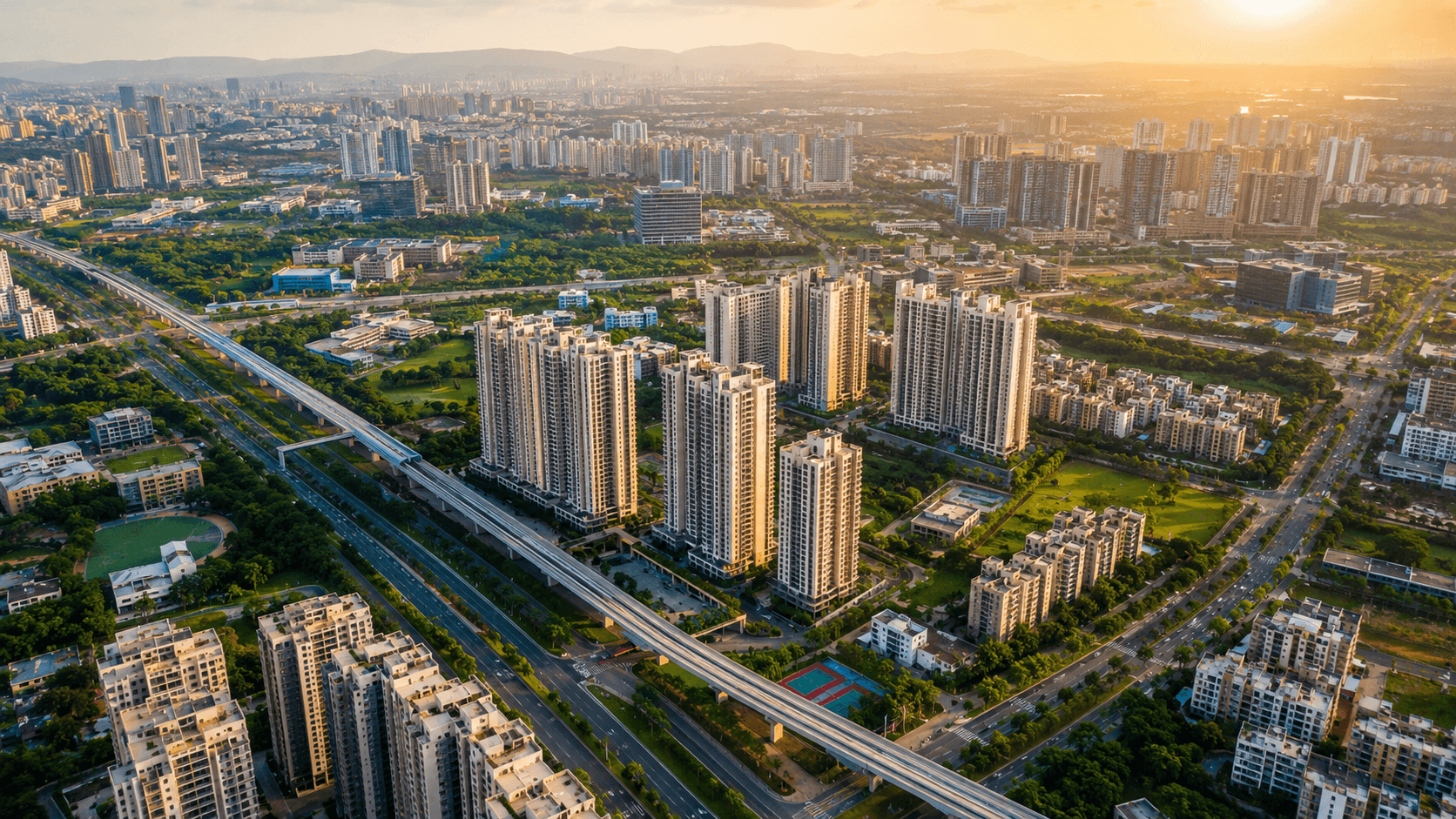
- 02Infrastructure development plans (like PMRDA Development Plan 2041 or Metro Line 3) are critical for checking connectivity timelines.
- 03Compare pricing on RERA carpet area, not super built-up area. A difference in carpet area is effectively paying more per square foot.
- 04Evaluate builder track record on the MahaRERA portal for completion delays, occupancy certificates (OC), and litigation before booking.
- 05Amenities carry high monthly maintenance costs. Assess long-term maintenance impact before choosing amenity-rich projects.
- 06Verify rental demand as a proxy for location quality and resale value, even if buying for self-use.
- 07Always conduct physical site visits (or request documented raw walkthrough videos for NRIs) to identify ground realities.
Over the last fifteen years helping families find homes in Pune, I've seen the same heartbreak play out again and again.
A smart, hardworking couple spends weeks researching. They visit a few sites, fall for a gorgeous sample flat, and book their dream home. Fast forward two or three years: the project is delayed, the living room is strangely smaller than they remembered, and their "quick 20-minute commute" now takes over an hour.
These aren't careless people. They just missed a few critical checks. And in Pune's market—where a new launch can set you back by ₹60 lakh to over ₹2 crore—those misses are expensive.
This isn’t a sales pitch for any single project. It’s the real, unfiltered advice I wish every buyer got before signing on the dotted line. I've focused on the Hinjewadi-Wakad-Punawale belt because that's where most IT buyers are looking right now.
If you're a first-time buyer, an NRI investor, or a family upsizing—read this before you pay that first cheque.
Why Buyers Lose Money on Good Projects
Here's something that might surprise you: most people don't lose money because they pick a bad project. They lose money because they pick a good project the wrong way.
You can choose a RERA-registered, well-located flat from a decent builder. But if you book without ever visiting the site, or without checking the actual carpet area, or without looking at the builder's past delivery record—you're still walking into big risks.
Yes, MahaRERA has made Pune's market cleaner than ever. But transparency only helps if you actually look at the information. Most buyers don't. They trust the glossy brochure and the salesperson's smooth talk. That’s exactly what this guide is here to fix.
> A quick insider tip: RERA Section 11 forces developers to upload approved plans, carpet area, and completion dates on the MahaRERA portal. It’s free to check at maharera.mahaonline.gov.in. Yet almost no one does it.
Mistake #1: Buying Based Only on Beautiful Brochures
Why we fall for it
Let’s be honest—those brochures are stunning. Lush green lawns, smiling families in sun-drenched living rooms, pools that look like five-star resorts. Developers spend crores on this stuff, and it works. It pulls at your heart.
This is especially dangerous with pre-launch projects. Sometimes all you get is a 3D render and a sample flat. You're essentially buying a promise.
What happens next
- The "5,000 sq ft clubhouse" turns out to be a 1,800 sq ft hall.
- Your "garden view" actually faces a neighbour’s wall and a garbage dump.
- The "landscaped podium" is a few pots on a concrete terrace.
- That gorgeous pool? Still "pending society approval" three years after move-in.
> Heads-up: Brochures are marketing, not a contract. Only what's written in your registered sale agreement and filed with RERA is legally binding.
How to avoid it
- Ask for the RERA-registered floor plan, not the pretty brochure version.
- Cross-check every amenity against the project's MahaRERA page.
- Ask specifically: "What's in Phase 1? What's 'planned' for later?"
- Request the AOP (Amenities and Obligations Plan)—it's a legal document.
- Visit an older project by the same builder. See what they actually delivered.
- [ ] RERA number verified on maharera.mahaonline.gov.in
- [ ] Seen the RERA floor plan (not just the brochure)
- [ ] Amenities match RERA filing
- [ ] Visited a completed project by this builder
- [ ] Lawyer reviewed the sale agreement
Mistake #2: Ignoring What's Coming (or Not Coming) in Infrastructure
Why we miss this
When you're comparing two similarly priced projects, it's easy to focus on what you see today. But Pune is changing faster than most Indian cities. An area that feels disconnected now could be gold after a metro station opens—or a nightmare if a new flyover blocks your view.
Real-life examples
- Someone who thought Punawale was "too underdeveloped" in 2021 missed out on 32% price appreciation over three years.
- A family who paid a premium for Baner's "great connectivity" now sits in the same traffic jam as everyone else, with no metro in sight.
- Another family bought near a "proposed road widening" and then endured three years of dust and noise.
How to get it right
- Look at the PMRDA Development Plan 2041—it shows future roads, metro lines, and reserved zones.
- Check Pune Metro Line 3 stations (Hinjewadi to Shivajinagar) – it's opening in phases from 2026.
- See if the proposed ring road will help (or hurt) your location.
- Look for approved IT parks or SEZs nearby—jobs drive demand.
- Check if the area falls under PMC or PCMC (PCMC often has a better infra pipeline).
> Insider note: Punawale isn't directly on Metro Line 3, but it's only 3–5 km from Wakad Chowk station. Once the metro reduces traffic on the Hinjewadi road, commute times from Punawale should improve significantly.
For a project that thinks this way about location: Unique Que 154, Punawale
Mistake #3: Not Comparing Carpet Area
Why it's overlooked
Indian real estate has three different "areas": carpet, built-up, and super built-up. And the differences are huge.
A builder might say "1,200 sq ft flat," but the RERA carpet area—the space you actually live in—could be just 820 sq ft. That's nearly one whole room less.
Since RERA, developers must price by carpet area. But many buyers still don't ask for it, and some builders still use super built-up in casual conversation.
What this means for your wallet
Let’s say two projects offer a "3 BHK" for ₹95 lakh.
- Project A: 980 sq ft carpet area.
- Project B: 820 sq ft carpet area.
You're effectively paying ₹1,159 more per square foot in Project B for the same usable space. That 160 sq ft difference is a whole kid's bedroom.
| Area Type | What it includes | Typical % of super built-up |
| --- | --- | --- |
| Carpet Area (RERA) | The space inside your walls (where you lay carpet) | 65–72% |
| Built-up Area | Carpet + walls + balcony | 80–88% |
| Super Built-up Area | Built-up + share of lobbies, lifts, corridors | 100% |
How to protect yourself
- Always ask: "What is the RERA carpet area?" Don't accept any other figure.
- Calculate the per-square-foot price on carpet area for every project.
- Compare the carpet-to-flat area ratio. Below 0.65 means an inefficient layout.
- Get the RERA floor plan showing exact carpet dimensions.
- [ ] Carpet area confirmed in writing
- [ ] Per sq ft price calculated on carpet area for all shortlisted projects
- [ ] Floor plan checked for room sizes and passage widths
- [ ] Balcony area excluded from carpet area (as RERA requires)
> Good to know: RERA says a builder can't take more than 10% of the agreement value as advance before a registered sale agreement is signed. Insist on that registered agreement—it must state the carpet area.
Mistake #4: Falling for Fancy Amenities (While Ignoring the Monthly Bill)
Why we love them
A rooftop infinity pool. A massive clubhouse. A co-working lounge. Indoor badminton. After living in a basic builder floor, these feel like luxury.
And developers know it. That's why they pack new launches with amenities, especially in Pune's mid-premium segment.
But here's the catch: amenities cost money. Monthly maintenance in amenity-heavy projects can range from ₹4 to ₹9 per sq ft. On a 1,000 sq ft flat, that's the difference between paying ₹4,000 vs ₹9,000 a month—an extra ₹60,000 every year.
What really happens
- You book a ₹1.1 crore flat with every amenity possible. Maintenance at ₹7/sq ft on 1,100 sq ft: ₹92,400 per year. Over ten years? Nearly ₹9.3 lakh.
- That Olympic-sized pool? It's only open six months a year because the society can't afford to run it. Eventually, they vote to close it.
- Meanwhile, a simpler project with lower maintenance frees up ₹3,000–4,000 a month—money you could put toward your home loan.
> Warning: If an amenity isn't listed in the RERA-registered project plan, it doesn't have to be built. "Proposed" or "planned" means nothing legally.
The right way to think about amenities
Be honest: what will you actually use?
- Young IT couple? Co-working space and gym.
- Family with kids? Safe play area, pool fencing, good landscape.
- Retired? Walking track and community hall.
| Amenity | Best for | Maintenance impact |
| --- | --- | --- |
| Pool + Jacuzzi | Young pros, families | High (heating, chemicals, lifeguard) |
| Gym | Almost everyone | Moderate |
| Clubhouse | Everyone | Moderate |
| Co-working lounge | IT, WFH | Low |
| Kids' play zone | Families | Low to moderate |
| Sports courts | Active residents | Moderate |
| Rooftop facilities | Premium projects | High |
Mistake #5: Ignoring the Builder's Track Record
Why we skip it
When you're excited about a new launch, the builder's history feels like a boring detail. You trust the brand, the pretty marketing, maybe a friend's recommendation.
But here's the truth: the builder's past is the closest thing you have to a guarantee. You're paying today for something that will exist in 2–4 years. Their history tells you if it'll actually happen.
What can go wrong
- A builder with a habit of 18-month delays means you pay rent + EMI for an extra 20 months.
- A builder who gives Occupancy Certificates late creates problems with your bank loan and possession.
- Any pending litigation? That can surface when you try to sell later.
How to dig deeper (it's not hard)
- Search the builder's name on the MahaRERA portal. See all their projects, completion dates, and complaints.
- Visit 2–3 of their completed projects. Talk to residents. Ask: "Are you happy? Did you get your OC on time?"
- Check if past projects received their Occupancy Certificate (that's the legal "fit to live" document).
- Search news and court records for any disputes.
- Ask your lawyer to run a title check on the builder.
- [ ] Searched builder's past projects on MahaRERA
- [ ] Verified possession track record for at least 2 projects
- [ ] Confirmed OC status of completed projects
- [ ] Spoke to residents in person
- [ ] No active litigation or serious complaints
> Key sign to watch: On MahaRERA, compare the "Original Completion Date" vs "Revised Completion Date" for past projects. If there's a consistent gap of 12–18+ months, that's a red flag—no matter what the sales team promises.
To see projects with a transparent builder: Infinity Evana, Punawale or Infinity Avana, Punawale
Mistake #6: Not Checking Rental Demand (Yes, Even for End-Users)
Why end-users ignore it
"I'm not an investor. I'm going to live in it. Why do I care about rent?"
Fair question. But here's the thing: rental demand is a proxy for location quality. An area where working professionals want to rent is also an area with good connectivity, good social infrastructure, and strong resale value. That matters even if you never plan to be a landlord.
For investors—especially NRIs booking from abroad—skipping this step is even more costly.
Real costs
- An investor buys in a weak rental area. The flat sits empty 3–4 months a year. That's ₹54,000 to ₹1 lakh lost annually on a ₹90 lakh property.
- An end-user buys in an area without strong IT demand. When they go to sell years later, the buyer pool is smaller, and it takes longer to exit.
- An NRI investor finds that every time a tenant leaves, it takes 6 months to find another. The yield disappears.
How to check rental demand
- Look at NoBroker, MagicBricks, and 99acres for the area. How many listings? How long have they been up?
- Who are the main tenants? IT professionals pay best and are most stable.
- Call 2–3 local brokers. Ask about average rent, vacancy periods, and tenant quality.
- See if the project has a rental management program (some builders partner with agencies for guaranteed rent).
| Locality | Main tenant | Avg 2 BHK rent (June 2026) | Vacancy | Est. gross yield |
| --- | --- | --- | --- | --- |
| Punawale | IT (Hinjewadi) | ₹18,000–25,000 | 3–4 weeks | ~4.0% |
| Wakad | IT, families | ₹22,000–32,000 | 2–3 weeks | ~3.6% |
| Hinjewadi | IT (all phases) | ₹20,000–28,000 | 2–3 weeks | ~5.0% |
| Baner | IT, expats | ₹25,000–40,000 | 4–6 weeks | ~3.2% |
Punawale projects with strong IT-rental fundamentals: Unique Que 154 rental profile
Mistake #7: Booking Without Ever Visiting the Site
Why we think we don't need to
Post-COVID, virtual tours got really good. A drone video, a 3D model, a smooth sales call—it can feel like you've seen everything.
But a video can't show you what the neighbourhood smells like at 7 PM on a Tuesday. It can't show you if the road floods in monsoon, or if the compound wall backs onto a noisy truck depot. Those things affect your daily life and your resale value—and you have to experience them in person.
Real stories
- A buyer books a "quiet, green" project. Turns out it's 200 metres from a major truck route. The video was shot facing the other way.
- An NRI gets possession and discovers the main entry road is shared with a commercial complex. Every morning, delivery trucks block it.
- A family buys because of a "school nearby" claim. The school is 8 km away on a congested road—not walkable at all.
- A buyer doesn't realize the "north-facing" unit directly faces a high-tension power line 50 metres away.
What to do on your site visit
If you can't go yourself, send someone you trust. NRIs: ask your broker or TSS Global to do a documented site visit and send a raw video—not the builder's polished version.
- [ ] Visit on a weekday at 8–9 AM (experience real peak-hour commute)
- [ ] Walk the entire perimeter of the project
- [ ] Check the road condition, especially the last 500 metres
- [ ] Drive to the nearest school, hospital, and grocery store
- [ ] Visit just after a heavy rain to check waterlogging
- [ ] Look for any industrial or commercial activity within 500 metres
- [ ] Note which direction your unit faces (sunlight, breeze, view)
- [ ] Talk to residents of any nearby completed society
> For NRIs: Ask your consultant to record a 15-minute walkaround video of the site and the surrounding 1 km radius on a weekday morning. The difference between that and a glossy builder video will shock you.
Arrange a verified site inspection: Book a site visit – Infinity Evana, Punawale
Expert Tips: What I Tell Every Buyer Before They Book
After hundreds of families and investors across Pune, here are the six things I say in every single consultation:
The TSS Global Homebuyer Checklist
Use this before booking any new launch or pre-launch project in Pune.
Legal & RERA
- [ ] Project RERA number verified on maharera.mahaonline.gov.in
- [ ] Status is "Valid" (not expired or lapsed)
- [ ] No active litigation or serious complaints against builder on RERA portal
- [ ] RERA completion date matches what sales team says
- [ ] Land title verified by independent property lawyer
- [ ] Sale agreement reviewed by lawyer before signing
Financial
- [ ] Total all-in cost calculated (base + GST + stamp duty + registration + parking + deposits)
- [ ] Home loan pre-approved before committing
- [ ] Payment plan is construction-linked (not time-linked)
- [ ] Monthly EMI + maintenance is under 40% of household income
- [ ] Advance limited to 10% until registered sale agreement is signed
Property
- [ ] RERA carpet area confirmed in writing
- [ ] Per sq ft price calculated on carpet area
- [ ] Floor plan reviewed (room sizes, passage width, natural light)
- [ ] Amenities cross-checked against RERA filing
- [ ] Maintenance charge rate confirmed, annual cost calculated
Location
- [ ] Site visited in person on a weekday peak hour
- [ ] All surrounding land uses identified (what's on each side)
- [ ] Nearest school, hospital, grocery store confirmed by driving there
- [ ] Infrastructure pipeline researched (metro, roads, IT parks)
- [ ] Rental demand verified with 2–3 local brokers
Builder
- [ ] 2–3 completed projects by same builder visited
- [ ] Residents of those projects spoken to about quality and society
- [ ] OC status of past projects confirmed
- [ ] Builder's RERA track record reviewed for delays
Frequently Asked Questions
1. What is a new launch project in Pune?
A residential development just announced for sale, usually before or during early construction. In Pune, new launches are common along the Hinjewadi-Wakad-Punawale corridor, Baner, Kothrud, etc. They offer lower entry prices but need the most due diligence.
2. New launch vs pre-launch – what's the difference?
A pre-launch is announced before RERA registration, often with a "pre-launch discount." Post-RERA, builders cannot legally take bookings before registration. Be very cautious of any pre-launch deal—verify RERA registration before paying anything.
3. Is it safe to buy a new launch in Pune in 2026?
Yes, if you do your homework. MahaRERA has made things much safer. Key steps: verify RERA registration, check builder track record, have a lawyer review the agreement, and insist on a construction-linked payment plan.
4. How do I check RERA registration for a Pune project?
Go to maharera.mahaonline.gov.in → 'Projects' → search by project name or registration number. Check that the status is 'Valid' and that the details match what the builder told you.
5. What is carpet area under RERA?
The net usable floor area inside your flat—the area where you can actually lay a carpet. It excludes walls, balconies, and common areas. All builders must price and describe flats using carpet area. Always ask for this number.
6. What are the hidden costs when buying a flat in Pune?
Beyond the base price: GST (5% for under-construction), stamp duty (5–6%), registration (1% up to ₹30,000), parking charges (₹3–7 lakh), development charges, society formation charges, and maintenance deposit. Total add-ons: roughly 12–18% of the base price.
7. Which new projects in Pune offer the best value in 2026?
It depends on your profile. For IT professionals near Hinjewadi: Punawale and Tathawade offer the best price-to-location ratio. For families: Wakad has the most mature social infrastructure. For investors: Punawale projects like Unique Que 154 offer strong entry pricing with metro-adjacent appreciation potential.
8. What should NRIs know before buying in Pune?
NRIs can buy residential property in India under FEMA guidelines. Key extra checks: ensure the builder accepts NRI payment through NRE/NRO accounts, get a power of attorney for a trusted local representative, and choose a project with professional property management for post-possession rental.
9. How long does it take to get possession in a new launch project?
Typically 3–4 years from launch. Always check the RERA possession date for that specific project. Then add a buffer of 12–18 months based on the builder's historical delivery record.
10. What is an Occupancy Certificate and why does it matter?
An OC is issued by the municipal corporation (PMC or PCMC) confirming the building is built according to approved plans and is fit to live in. Without an OC, you cannot legally connect utilities, get a home loan for resale, or register the property in some cases. Always confirm OC status before taking possession.
11. What is the best residential project in Pune for an IT professional?
There's no single "best"—it depends on your office location, budget, and family needs. For Hinjewadi-based IT pros, Punawale and Wakad offer the best balance of commute, price, and quality. Projects like Infinity Evana in Punawale are designed specifically for this profile.
12. What is property investment in Pune like in 2026?
Pune remains one of India's strongest property investment markets. The IT corridor (Hinjewadi, Wakad, Punawale) offers 4–5.5% rental yields and 8–12% annual appreciation in growth micro-markets. Infrastructure catalysts like Metro Line 3 (opening mid-2026) are expected to sustain appreciation through 2028.
13. How do I compare flats in Pune across different projects?
Compare on: RERA carpet area price (per sq ft), builder track record, location fundamentals (commute, schools, hospitals), total all-in cost, payment plan type, RERA possession date, and amenity-to-maintenance ratio. Avoid comparing on super built-up area or brochure prices.
14. What is a construction-linked payment plan?
Instalments tied to physical construction milestones—foundation, each floor slab, finishing stage, etc. This is safer than a time-linked plan because you pay only when actual progress happens, reducing your risk if the builder slows down.
15. Should I buy a ready-to-move-in flat or a new launch in Pune?
Both have merits. Ready-to-move has no construction risk, gives immediate possession, and no GST. New launch offers 15–25% lower entry pricing (the "new launch discount") but carries completion risk. If you have 3–4 years before you need to move in, a well-researched new launch in a good location from a credible builder is usually the better financial decision.
People Also Ask
(For search engines)
- What documents should I check before buying a flat in Pune?
- Is Punawale a good place to invest in property in 2026?
- What is the RERA possession date and is it binding?
- How much stamp duty do I pay for a new flat in Pune?
- Can NRIs buy flats in Pune under construction?
- What is the difference between RERA carpet area and RERA built-up area?
- How do I verify a builder's track record in Pune?
- Is Wakad better than Punawale for IT professionals?
- What are pre-launch projects in Pune and are they legal?
- How much does a 3 BHK flat in Punawale cost in 2026?
- What is the average rental yield in the Hinjewadi corridor?
- How does Metro Line 3 affect property prices near Hinjewadi?
- What is an AOP in a real estate project?
- What happens if a builder delays possession?
- Is Hinjewadi Phase 3 a good investment in 2026?
- What are the maintenance charges in new residential projects in Pune?
- How can I verify if a project has received its Occupancy Certificate?
- Which areas near Hinjewadi IT Park have good schools?
- What is the first step to buying a flat in Pune as an NRI?
- How do I compare two new launch projects in Pune objectively?
Conclusion
Pune's residential market is one of the most exciting in India right now. The number of good new launch projects—especially along the Hinjewadi corridor, Baner, Kothrud, and East Pune—is higher than ever. For a buyer who does their homework, 2026 is a fantastic time to jump in.
The people who get hurt aren't the ones who chose the wrong city or the wrong neighbourhood. They're the ones who rushed, trusted too easily, and skipped the diligence that would have taken an afternoon and saved them years of regret.
The seven mistakes here are avoidable. The checklist above is doable. All it takes is a little discipline—the willingness to slow down for a few days, ask the right questions, and verify before you commit.
If you need help evaluating a project in Punawale, Wakad, or the Hinjewadi corridor, the TSS Global team has guided hundreds of buyers through this process. We don't believe in pressure. We believe in informed decisions.
Ready to evaluate a project the right way?
→ Explore Unique Que 154, Punawale – 3 BHK investment homes
Talk to a TSS Global advisor before you book:
→ Schedule a consultation – Infinity Evana & Unique Que 154
Published by TSS Global | tssglobal.in | Pune Real Estate Consultants | June 2026
Frequently Asked Questions
A residential development just announced for sale, usually before or during early construction. In Pune, new launches are common along the Hinjewadi-Wakad-Punawale corridor, Baner, Kothrud, etc. They offer lower entry prices but need the most due diligence.
A pre-launch is announced before RERA registration, often with a "pre-launch discount." Post-RERA, builders cannot legally take bookings before registration. Be very cautious of any pre-launch deal—verify RERA registration before paying anything.
Yes, if you do your homework. MahaRERA has made things much safer. Key steps: verify RERA registration, check builder track record, have a lawyer review the agreement, and insist on a construction-linked payment plan.
Go to maharera.mahaonline.gov.in → 'Projects' → search by project name or registration number. Check that the status is 'Valid' and that the details match what the builder told you.
The net usable floor area inside your flat—the area where you can actually lay a carpet. It excludes walls, balconies, and common areas. All builders must price and describe flats using carpet area. Always ask for this number.
Beyond the base price: GST (5% for under-construction), stamp duty (5–6%), registration (1% up to ₹30,000), parking charges (₹3–7 lakh), development charges, society formation charges, and maintenance deposit. Total add-ons: roughly 12–18% of the base price.
It depends on your profile. For IT professionals near Hinjewadi: Punawale and Tathawade offer the best price-to-location ratio. For families: Wakad has the most mature social infrastructure. For investors: Punawale projects like Unique Que 154 offer strong entry pricing with metro-adjacent appreciation potential.
NRIs can buy residential property in India under FEMA guidelines. Key extra checks: ensure the builder accepts NRI payment through NRE/NRO accounts, get a power of attorney for a trusted local representative, and choose a project with professional property management for post-possession rental.
Typically 3–4 years from launch. Always check the RERA possession date for that specific project. Then add a buffer of 12–18 months based on the builder's historical delivery record.
An OC is issued by the municipal corporation (PMC or PCMC) confirming the building is built according to approved plans and is fit to live in. Without an OC, you cannot legally connect utilities, get a home loan for resale, or register the property in some cases. Always confirm OC status before taking possession.
There's no single "best"—it depends on your office location, budget, and family needs. For Hinjewadi-based IT pros, Punawale and Wakad offer the best balance of commute, price, and quality. Projects like Infinity Evana in Punawale are designed specifically for this profile.
Pune remains one of India's strongest property investment markets. The IT corridor (Hinjewadi, Wakad, Punawale) offers 4–5.5% rental yields and 8–12% annual appreciation in growth micro-markets. Infrastructure catalysts like Metro Line 3 (opening mid-2026) are expected to sustain appreciation through 2028.
Compare on: RERA carpet area price (per sq ft), builder track record, location fundamentals (commute, schools, hospitals), total all-in cost, payment plan type, RERA possession date, and amenity-to-maintenance ratio. Avoid comparing on super built-up area or brochure prices.
Instalments tied to physical construction milestones—foundation, each floor slab, finishing stage, etc. This is safer than a time-linked plan because you pay only when actual progress happens, reducing your risk if the builder slows down.
Both have merits. Ready-to-move has no construction risk, gives immediate possession, and no GST. New launch offers 15–25% lower entry pricing (the "new launch discount") but carries completion risk. If you have 3–4 years before you need to move in, a well-researched new launch in a good location from a credible builder is usually the better financial decision.